
In Hebrew (fem.): שוטפת
Phonetically: Sho-tef-eht
“I’m hanging your pants up over here!” I called to Ido as he waded out into the turquoise waves.
My husband. My husband. It was the third day I could officially call him that.
After a year of bureaucratic bullshit and Covid restrictions, we had finally managed to travel to the Seychelles Islands off the eastern coast of Africa, and get married.
And now we were enjoying our island honeymoon with two of our best friends who had made the journey with us, specifically to be there for us during our hard-won 7 minute ceremony.
Such incredible joy.
With the ankles of Ido’s hiking pants in my hands, I flicked the waistband over a low-hanging tree branch, hoping the sea breeze would help air out the sweat before our return journey later that afternoon.
I took a minute to just look out into the bay, white sand sweeping down into turquoise gem-like waters, ringed with ridged boulders and shaggy palm trees. Far away on the horizon line, Silhouette Island was gathering thick white clouds above its mountains, like a steaming volcano.
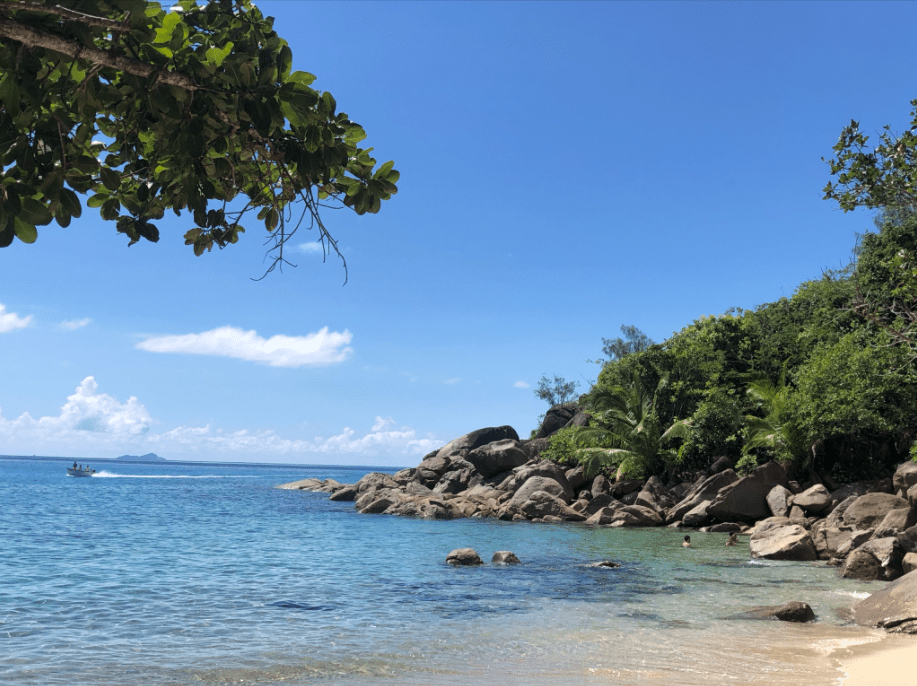
Anse Major – that was the name of this specific beach. And it had been worth the extra work to get here.
Unaccessible by car or bicycle, the only way to access this Instagram-perfect beach was either by boat or an hour-long hike through the humid tropical jungle.
The four of us hike together often in Israel, so we had woken up early to make the hike.
The hot and sunny trail on the northwest perimeter of the island had wound in and out of the jungle, sometimes a rocky path with vistas of the jewel-like water and Silhouette Island, at other times a root-tangled footpath (bordered with gigantic spiderwebs and their oversized tenants) through the thick jungle.
And the Anse Major beach didn’t disappoint.
After smearing on as much 50 SPF sunscreen as possible for the punishing equatorial sun, we threw ourselves into the water. We snorkeled and dived to see the hundreds of black sea urchins clustered on the sea floor, and the flicker of an occasional cobalt-blue tropical fish. We perched together on a mussel-studded boulder, knees drawn to our chests, and just took it all in.
Ido and I had both been high energy this morning, eager to dive into our fourth day of adventuring on the island.
But, during the hike, our two friends had hung back and taken a slower pace on the trail to talk privately, leaving Ido and I to forge ahead.
We had given them their space. Now, I looked back over my shoulder, and saw them sitting back on the beach. I kissed Ido and splashed back toward the beach to visit with them and to ask the wife – my dear ginger-haired friend – if she wanted to paint some watercolors together on the beach.
I fought the sucking waves and soft sand to get to back to our towels and bags, grinning, greeting them cheerily.
That’s when my dear friend, The Ginger, walked toward me.
Her shoulders were hunched, and her hands were clasped in front of her.
“I’m sorry – I’m so sorry, I had no idea,” she said, her voice thick and eyes filled with tears.
Tears?
Still dripping sea water, I cocked my head, utterly confused.
Two weeks ago, The Ginger and her husband had come over to our house for a planning session.
After all, we were trying to blitz the planning of a 10-day trip across multiple islands, with less than 2 weeks notice.
A trip that usually requires months to plan comfortably.
So everyone flipped open their laptops and started researching.
Flights. Lodging. Prices. Rental cars. Inter-island flights and ferries.
Ido looked up and said something in Hebrew to the husband.
The husband replied in Hebrew. Then The Ginger chimed in – also in Hebrew. And Ido replied to her. In Hebrew.
“In English?” I asked loudly.
They glanced at me, with a look of surprise.
Oh right – she doesn’t speak Hebrew.
“We’re just trying to figure out how to get between the islands,” the husband replied.
“I heard that there was a ferry between the islands – would that work?” I said.
He shook his head.
“That’s what I was just telling Ido and The Ginger – with Covid, the ferry schedule is unreliable.”
I felt the usual heat of frustration scorch the back of my neck.
I can’t pick this stuff up in the flow of conversation. Not when the conversation is in Hebrew.
“Ah, ok,” I said.
The husband turned back to Ido. More Hebrew.
Ido replied in Hebrew. Then the husband turned to his wife, The Ginger, and fired off a question in Hebrew. And she replied in Hebrew. Then more Hebrew from Ido.
I felt the flush of frustration radiate down my arms.
6 years ago, I had single-handedly researched and planned an out-of-state trip for me and my siblings. Everything, from activities, to budget, to our lodging, to finding a long weekend that worked for all of us – I had handled every detail.
… but in Hebrew?
“GUYS,” I said, loud and sharp, intentionally interrupting the flow of Hebrew. “If you don’t speak English, I can’t help. You’ve GOT to speak English.”
The same surprised expressions.
Oh right – she didn’t understand that.
It wasn’t malicious. It never is. It’s just an easy thing to forget.
The day after our wedding (the day before our hike to the Anse Major beach) Ido, The Ginger and I had forced our ill-suited rental car up the steep mountain slopes of Mahe Island for a special sun-printing fabric class.
When we finally managed to get our glorified golf cart to the top of that mountain road, we were awe-struck by the view. Stretched out below us, in picturesque perfection, was the curve of the Beau Vallon Bay on the western side of the island. Lush green mountains rolled up across the bay and up toward the sky.
This was our view for the rest of the class.
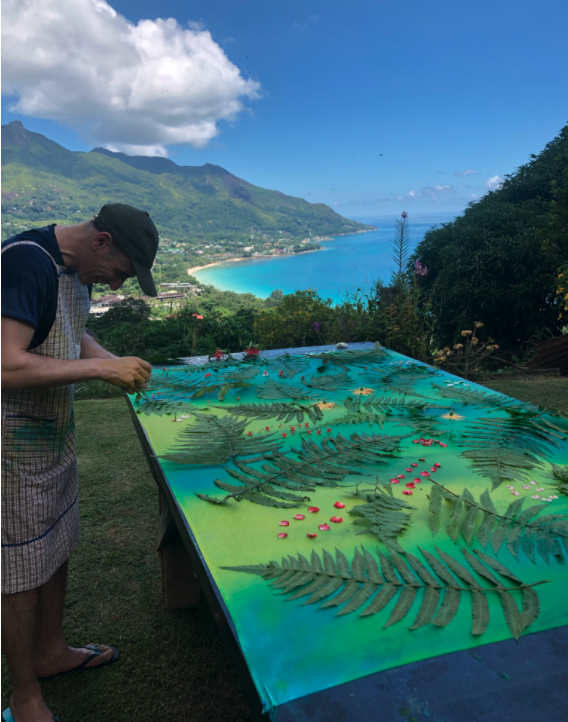
We helped them move three large tables into the open sun of the front lawn, and got to work.
Moving around the lush yard, we began to pick fistfuls of flowers. Juicy pink hibiscus. Buttery white frangipanis. Round wine-red begonias. Small star-shaped glionnetia on long stems.
We took them, and stacks of palms leaves, and carefully spread them across the wide swathes of our thin cloths. The dyes soaked in the cloth and dried, turning it shades of green, yellow and orange. Bleached patches began to appear under the shadows of the leaves and flower petals. The purple juices of the hibiscus seeped out of the blossoms and into the cloth.
It was absolutely magical.
But there was an extra element to the day that made it extra enjoyable for me.
To my delight, the primary language in the islands is English. And, as an unexpected bonus, I learned that the woman running the class, Stephanie, was born in Ohio just like me.
Without the language barrier, I felt like I had 40% of my brain (and energy) back here in the islands.
Stephanie’s husband, a Seychelles native, also spoke English but in an accent thick with French and Creole. But I understood him perfectly as he walked us through the process and splashed extra dye on our cloths with dark hands.
I teased, I bantered, I asked questions, I asked him to tell me stories about his life growing up on the islands. I befriended Stephenie, asked her how a girl born in Ohio ended up living in the Seychelles Islands, eager to learn more about how she ran her creative business.
Ido was just as gregarious as I, understanding almost as much of the English as I did.
And usually, The Ginger is very warm and sociable, too.
But I was so enjoying the ability to talk freely in English with the workshops owners … that I didn’t notice how unusually quiet she had been for most of the workshop.
After an hour of arranging blossoms on the outdoor tables, Stephanie’s husband started to express concern for my light skin under the equatorial sun.
“Heather, Heather, you burn, come, come here,” he said, his accent thick, dark hands gesturing me toward the shade of their workshop.
” … What did he say?” The Ginger asked me.
“He’s concerned I’m getting a sunburn,” I replied.
With the ease of practice, Stephanie’s husband cracked open a coconut and spread the protective juices and flesh all over my reddening skin, telling me about the medicinal properties of coconut juices as he rubbed it into the skin of my forehead and cheeks, and combed the fresh oils through my short brown hair.
I felt warm, loose, like the coconut oil and fleshy clumps on my skin. Bright like the island sun.
“What are you sorry about?” I asked The Ginger, genuinely confused.
We were on the Anse Major beach, and her back was to the paradisal turquoise cove, her hands clasped in front of her.
The story came spilling out with the tears down her cheeks.
While her English is good and functional, it is far from truly fluent.
My English is usually easy enough for her, in my accent-free Midwest diction.
But when you threw in a crumpled Creole accent, it became incomprehensible to her.
Little did I know that, up on that mountaintop, our roles had reversed without my knowing.
She was no longer the native speaker offering translations. I had become the native speaker – and suddenly she was the immigrant in need of translation.
On that sunny mountaintop, she had been the only person who wasn’t fluent in English. And it caught her off-guard.
When Stephanie’s husband gave instructions in his thick accent, she didn’t understand a word he said.
She didn’t say anything about it until we were at the beach at Anse Major – our fourth day on these English-speaking islands.
For me, it was the fourth day of easy English, a return to my native tongue and, honestly, what felt like my full self. A full self I can’t have or express in Israel.
For her, it was the fourth day of living … well, living like I do in Israel.
“I had no idea,” she said tearfully. “I’m so sorry, I’m so sorry if I didn’t try harder to help you. I had no idea. I didn’t understand.”
Two days later, on the idyllic nearby island of La Digue, the four of us got cleaned up and went out to dinner together at the Le Nautique restaurant before The Ginger and her husband left for Israel the following morning.

Over the past two days, they had slowed down their travel pace to accommodate for the unexpected stress of the language barrier and a flare-up of her husband’s back problems. And after an easier pair of days traveling at their own pace, the Ginger was visibly more relaxed on the other side of that white tablecloth.
It was an interesting side-effect of this trip that, in the heat of planning, I hadn’t anticipated.
It was here in these African islands, for the very first time, that my dear friend The Ginger got to see the English-speaking side of me.
Not just me speaking English. But me being a native speaker in an English-speaking environment.
You see, I had met and befriended both Ido and her husband on the same day while they were traveling in Florida. Both of them had seen who I was in an English-speaking country.
But The Ginger never had.
She only knew me as The Immigrant.
Overwhelmed. Raw. Quiet and uncommunicative with strangers. Uncomfortable leaving the house on my own. Overly stressed out by unreadable parking signs and menus in Hebrew.
But, for just a few days, she got to see me as A Native.
Gregarious. Outgoing. Bold. Energetic.
She caught a glimpse of me without the weight of Hebrew.
“I didn’t realize how super super outgoing and extroverted you really are,” she said.
We talked about it for a few minutes at the table. How her few days here with a language barrier made everything feel SO much harder, made her feel like a prisoner in her own head when she couldn’t express herself in English, or understood what others said to her.
“That’s EVERY. DAY. in Israel for me,” I emphasized. “For two whole years.”
She nodded gently. “I know that now,” she said.
She turned to her husband.
“So, this English version of Heather, with all of her outgoingness and energy, how do we get her back to Israel?”
She and her husband are problem solvers with good hearts. So they immediately started to brainstorm plans for getting me fluent in Hebrew as fast as possible, maybe she can do this or maybe she can —
But as they talked and planned, I just felt this heavy reminder:
I am about to lose this again.
I felt heartsick. A lead weight in my stomach.
“Guys, guys, guys,” I said, talking above their planning. “Just let it go for now. Just let me enjoy it for now, while I have it.”
My throat suddenly constricted with tears.
“Right now, in an English-speaking country, it’s like I have running shoes on and am able to sprint for the first time in more than a year. And it’s wonderful! It really feels amazing. But when I go back to Israel … when I go back, I’ll have to walk on crutches again. And I’ll have to use those crutches for a very long time. There’s really no way to bring back this version of myself until I’m fluent in Hebrew. So, let me just enjoy running without crutches for now, while I can.”
The Ginger and her husband traded a look. Then nodded sympathetically.
Two months later, we traveled to northern Israel with some of our friends, including The Ginger and her husband.
As we sat next to the pool, the group conversation made it’s quick and easy devolution into Hebrew.
This effectively removes me from the conversation.
Again, it’s never done with ill-intent. Just forgetfulness.
Most of the time, I’m too tired to fight it.
By now, it’s happened to me thousands of times.
I felt my eyes glaze over, and I tuned out, reaching for my phone.
But The Ginger saw me. She caught me shrinking.
And in loud and deliberate English, she suddenly insisted, “Let’s play a game – a game in English. Let’s go through the alphabet – starting with ‘A’, let’s list off animal names in English.”
Her younger sisters protested in Hebrew at first, finally saying in broken English, “But, nu, I not so good in English – is hard for me.”
The Ginger was firm. “I’ll go first. For A, I’ll say ‘alligator’. Your turn,” she said, gesturing to her sister.
Then The Ginger turned to look at me, and gave me the smallest smile.
I can’t tell you how much I loved her in that moment.
 heatherboyer.net